Catalyzing Actionable Research in Prosocial Game Design
We report on our researcher-practitioner convening with Roblox
.jpg)
Last October, we partnered with Roblox to bring together more than 40 researchers and Roblox team members for a one-day workshop designed to share insights and catalyze new research around a shared challenge: fostering connection in social gaming. You can read the full report here.
The problem we set out to address is one PDN knows well. A growing body of academic research explores how design choices can encourage prosocial outcomes online, and many technologists are looking for evidence-based ways to build healthier platforms. Yet these groups often work in silos. Research is frequently produced without a clear path to implementation, while platform teams face time, funding, and practical constraints that make it difficult to find, interpret, and apply academic insights within real-world systems.
This workshop was designed to change that.
Rather than centering abstract discussion, the day was structured around collaboration. Researchers and Roblox team members worked side by side to identify concrete design challenges, generate ideas, and develop those ideas into actionable design concepts and research plans. To support this process, PDN introduced Design Direction Cards, a simple tool to help participants move quickly from ideation to solution building.
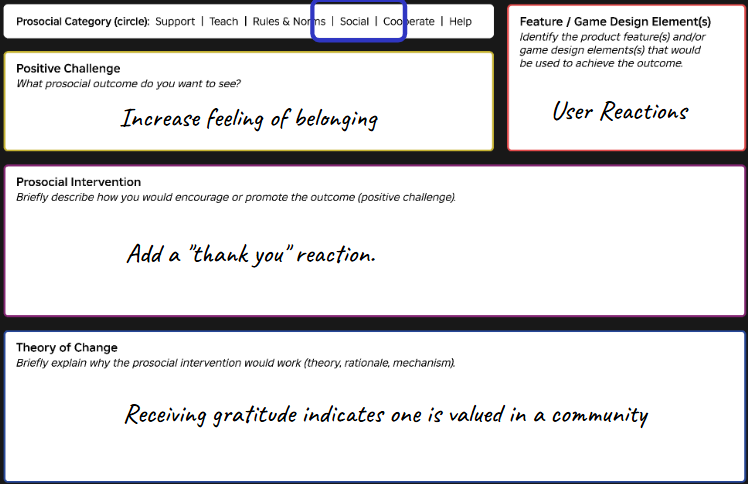
Each card captured what we see as the essential elements of an actionable design idea: 1) the positive challenge a design would address, 2) the feature or game design element a design would build onto, 3) what the intervention would do to foster a prosocial outcome and 4) the theory of change the intervention was based on. Participants also identified which of six prosocial categories their idea best fit into: Support, Teach, Rules & Norms, Social, Cooperate, or Help. These categories helped teams align on different approaches to fostering connection while keeping the workshop grounded in shared goals.
The workshop produced dozens of design ideas aimed at fostering connection in social gaming, fourteen of which participants identified as especially promising. Nine were developed into detailed designs and research plans, and six have since received funding to move forward as research projects. You can read more about those awardees here.
We see this convening as a proof of concept model for how platforms and researchers can work together to produce actionable, practice informed research. Over the coming months, PDN will share insights and findings from this work, including results from the funded research projects testing the design interventions developed during the workshop.
Does this look like a promising model to you? If you’re a platform, product team, funder or organization interested in exploring how similar convenings can foster healthier, more prosocial digital spaces, reach out. We would love to support you.
About the Prosocial Design Network
The Prosocial Design Network researches and promotes prosocial design: evidence-based design practices that bring out the best in human nature online. Learn more at prosocialdesign.org.