Norms & Rules Setting Update
New research refines how online norms reminders work and when they backfire for platforms.
Online field experiments have repeatedly found that reminding people of rules and norms can improve behavior and increase participation in online communities. Studies on Reddit, Nextdoor, and Facebook all showed reductions in rule-breaking or re-offending when users were reminded of norms. But newer research suggests that not all norm reminders work the same way. This update explains how new evidence led us to refine how the Prosocial Design Library categorizes “Reminder of Norms.”
Reminder of Norms: How It Started
“Reminder of Norms” was one of the first evidence-based design patterns in our library and remains one of only two patterns labeled as validated.
It first entered the library following a study by Nathan Matias in collaboration with the r/science subreddit. In a field experiment, discussions were randomly assigned to include a sticky post reminding users of the subreddit rules, encouraging respectful discussion, and subtly signaling enforcement by mentioning the community’s 1,200 moderators. A control group of discussions had no sticky.
The results were clear. Posts that received the intervention were 8% more likely to have new-user comments comply with the community’s rules. At the same time, as an indication that rules can make people feel safer to engage, the reminder increased the likelihood that new users would comment by 70%. In short, reminding people of the rules both reduced harmful behavior and increased participation from newcomers.
Two additional field experiments reinforced this finding. A Nextdoor study randomly assigned 312 new groups to either display group norms as people joined or show no norms at all. Groups that displayed norms saw fewer comments flagged by other users. Facebook ran a field experiment testing whether reminding users of rules after they broke one would reduce reoffending. It did.
With three field experiments showing strong positive effects, “Reminder of Norms” earned its validated status.
Reminder of Norms: How It’s Going
Recently, our library team reviewed two newer studies examining the effects of norms reminders. This led us to two realizations:
- There are many different types of rules and norms reminders.
- They may not all produce the same outcomes.
These newer studies were not full field experiments, which test interventions in real-world environments, but they used methods with strong ecological validity, meaning the experiments closely resembled real online experiences. In one study, participants were asked to think about what others would do or would approve of before entering a simulated social media feed. This intervention increased positive engagement, aligning with earlier findings.
A second study asked participants to “stay civil, respectful and on topic” and to “avoid harassment, discrimination and offensive language” before joining a subreddit created by the researchers. This study found a backfire effect among some users.
While there are methodological reasons to interpret this second result cautiously, it highlighted the need for a more nuanced understanding of norms reminders.
Identifying What Matters
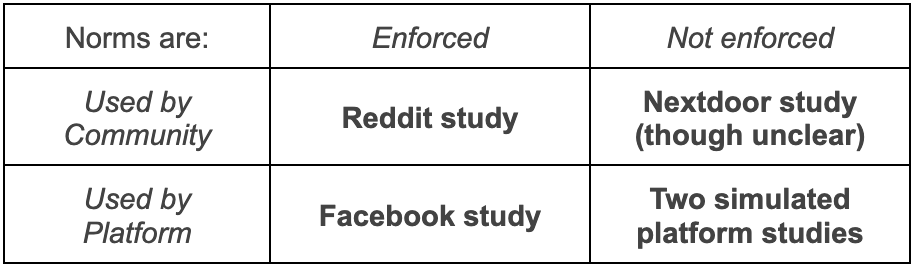
We asked: if we want to get more precise, what dimensions explain differences in outcomes? We saw the variations in approaches fell into different quadrants of two key dimensions, each with its own effect on how we behave.
- Whether norms are associated with a community: Humans are social animals who want to belong. Social psychology research consistently shows that people adopt behaviors they see in groups they identify with, especially when those behaviors are socially approved. Norms are most powerful when they come from a group people want to be part of.
- Whether norms are enforced: A separate but powerful driver of behavior is the desire to avoid consequences. When rules are enforced, people often comply to avoid penalties such as suspension or bans.
When we mapped the studies we reviewed across these dimensions, clear patterns emerged.
Three Kinds Of Norms And Rules
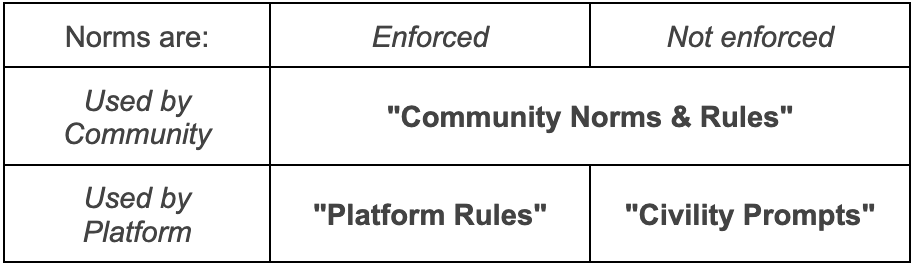
We could have created four categories based on these dimensions, but instead we chose three. For now, we’ve kept them together as one design pattern with three variations.
When norms clearly come from a community people want to belong to, their power largely comes from social belonging itself. Whether enforcement is explicit appears less important in this context. This led us to create a category called:
- Community Norms & Rules: Reminders tied to a specific community’s identity and shared expectations. Evidence strongly suggests these are effective in encouraging positive behavior.
For platform-level interventions, enforcement becomes more important. Large platforms function less like communities and more like cities that manage many communities. When platforms remind users of norms, we distinguish between two cases.
- Platform Rules: These reminders explicitly signal enforcement. Their effectiveness likely comes from users wanting to avoid negative consequences.
- Civility Prompts: These are platform reminders that do not signal enforcement. They may activate empathy or general social expectations, but they can also feel preachy or paternalistic if poorly designed.
What This Means For Prosocial Design
The key takeaway is that the type of norms reminder matters. Evidence strongly supports the effectiveness of:
- Reminders of Community Norms & Rules
- Reminders of Platform Rules
However, Civility Prompts are more uncertain. They may help in some contexts but can backfire if users feel lectured or patronized. For these prompts to work, they likely need careful design that appeals to empathy, shared goals, or effective communication rather than finger-wagging.
As the evidence base grows, the library will continue evolving to reflect a more nuanced understanding of how prosocial design works.
About the Prosocial Design Network
The Prosocial Design Network researches and promotes prosocial design: evidence-based design practices that bring out the best in human nature online. Learn more at prosocialdesign.org.