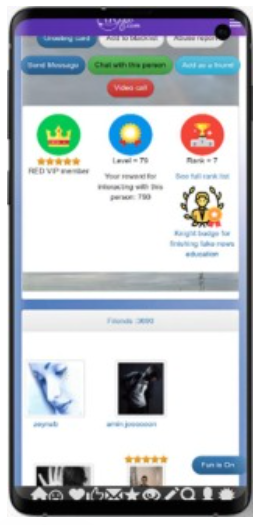
What It Is
A prompt that offers a small reward for reviewing and personalizing privacy settings.
Civic Signal Being Amplified
When To Use It
What Is Its Intended Impact
To encourage people to review their privacy settings, including who can see their information or contact them, supporting greater control over their online experience.
Evidence That It Works
Evidence That It Works
Hajarian et al. (2025) examined the impact of a prompt on an Iranian social networking site (Gegli) that popped up when a user encountered another person’s privacy restrictions The prompt offered points in Gegli's internal reward system if the user changed their privacy settings, and gave them the ability to do so within the pop-up.
Among active users who encountered the prompt, a sizable number - about 60% - personalized their settings. The researchers compared the users who personalized their settings when prompted to those who did not and observed that personalizers were more active on the platform. A survey of 60 users found that those who personalized their settings were more likely to report being satisfied that unwanted contact, threats, and arguments were absent. General privacy satisfaction, however, did not differ significantly between the groups.
While this one study demonstrates the viability of a privacy-setting prompt, its design – in particular the self-selection of comparison groups – does not let us say that the prompt leads to a more positive user experience or to other prosocial outcomes. Stronger evidence is needed to establish whether the prompt improves users’ sense of agency or experiences of safety. However, the high percentage of users (~60%) who took action to change their privacy settings suggests it may be an effective way to encourage users to exercise their agency around privacy.
Why It Matters
Privacy controls give people a way to set boundaries around their information and interactions. Although estimates vary, there is some evidence that very few social media users exercise their agency and set their privacy controls to their preferences. This study offers a promising design solution for supporting users’ agency over their privacy. Further studies could test whether prompts and rewards help users exercise that control and improve their experiences of safety.
Special Considerations
Examples