
What It Is
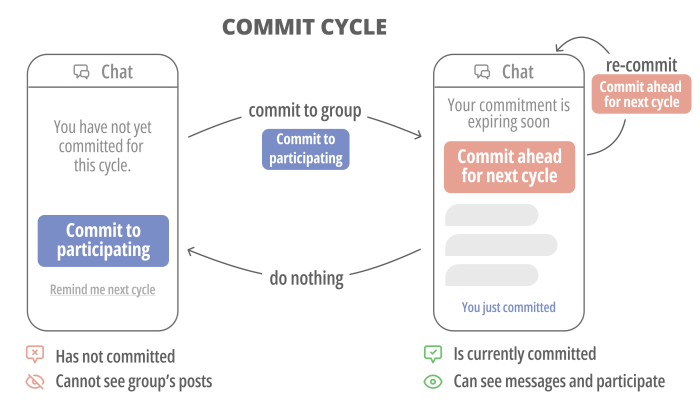
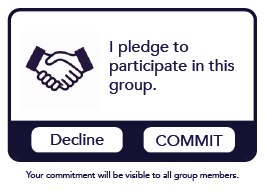
Periodic requests sent to participants asking them to commit or re-commit to participating in a group. If they do not commit, members are removed from the group. If they do, their commitment is seen by all group members.
Civic Signal Being Amplified
When To Use It
What Is Its Intended Impact
Commitment pledges are intended to increase user participation, group activity, and retention. They also aim to provide users with increased likelihood of psychological safety and feelings of value and importance while increasing inclusive participation.
Evidence That It Works
Evidence That It Works
Popowski et al., 2024 conducted a study in which participants were placed in common interest groups for three weeks on a mobile group chat platform called Commit and asked to engage in conversation with each other. Participants were randomly assigned to either a treatment condition in which they were asked to ‘commit’ every two days (and risk being removed if they did not), or to a control condition in which participants were nudged to participate (with no specific consequence).
Results showed that if participants were in the commit condition, they sent double the number of messages and were more likely to remain active. (Note: all effects we include are statistically significant, unless otherwise stated.) However, being in the commit group did not increase inclusive participation (i.e. there was no reduced gap between frequent and infrequent contributors). Qualitative interviews conducted after the experiment suggest that being in the commit group made people feel safer, more comfortable to contribute, and more able to rely on each other.
While the results above are promising, it is important to note that the study was conducted with students in a course for credit and on a simulated social media platform which limits the study's generalizability.
Why It Matters
Many online groups, including those meant to create community and provide social support, struggle to have sustained participation. Many don’t survive past the initial days before they are able to reach critical mass. Such online groups - and the members they are intended to support - benefit from designs that can help them reach critical mass, sustain engagement and thrive.
Special Considerations
As may be implicit, this intervention was designed and tested with groups that have a common interest in mind, so it is unclear - and perhaps unlikely - that it would be effective on a large social media platform
Including commitment as a prosocial design intervention hinges on the assumption that those committing will be engaging in prosocial contributions.
Examples